PhD Cell Biologist · AI/ML Scientist
Saman
Hussain
A cell biologist working at the intersection of advanced microscopy and AI.
Explore research →
PhD Cell Biologist · AI/ML Scientist
A cell biologist working at the intersection of advanced microscopy and AI.
Explore research →
01About Me
I am a cell biologist with expertise in live fluorescence imaging, hair cell biology, and the application of machine learning to biological problems. My research has centered on how sensory hair cells in the inner ear and lateral line detect, encode, and transmit signals to the brain.
I completed my PhD in Biology at Harvard University, then worked as a neuroscientist at the National Institutes of Health (NIH/NIDCD), where I published on ribbon synapse development and spontaneous calcium signaling in stereocilia.
I currently work as an independent contractor with Mercor Intelligence, designing and evaluating expert-level scientific problems used to train frontier AI models (Google Gemini, Claude and ChatGPT) on PhD-level reasoning in the life sciences.
02Research & Projects
Using high-resolution live cell microscopy in zebrafish, we found that small ribbon precursors spread throughout developing hair cells, then move along microtubule networks to the presynaptic active zone, fusing into mature ribbons. Disrupting microtubules prevents normal synapse formation, with implications for age-related and noise-induced hearing loss.
Using genetically encoded Ca²⁺ sensors and advanced microscopy, we detected spontaneous Ca²⁺ transients in stereocilia in the absence of movement. This activity is abolished by MET channel blockers and is conserved across mouse and zebrafish. This work revealed new insights into channel assembly, maturation, and function.
The MreB protein, an actin homolog in Bacillus subtilis, acts as a curvature sensor that aligns with regions of greatest membrane curvature to guide cell wall synthesis. Even in spherical mutants, local curvature fluctuations create bulges that MreB exploits to regenerate rod shape. This work determined the mechanism behind rod shape formation and identified new potential antibiotic targets.
Using a gliding assay with immobilized myosin II and purified actin, we found that filament collisions progressively reduce inter-filament angles, driving emergent collective alignment. High actin and myosin concentrations promote ordered motion, but only up to a threshold, beyond which excess myosin causes disorder.
AI/ML, and computational biology projects focused on image analysis, tracking, and interactive visualization.
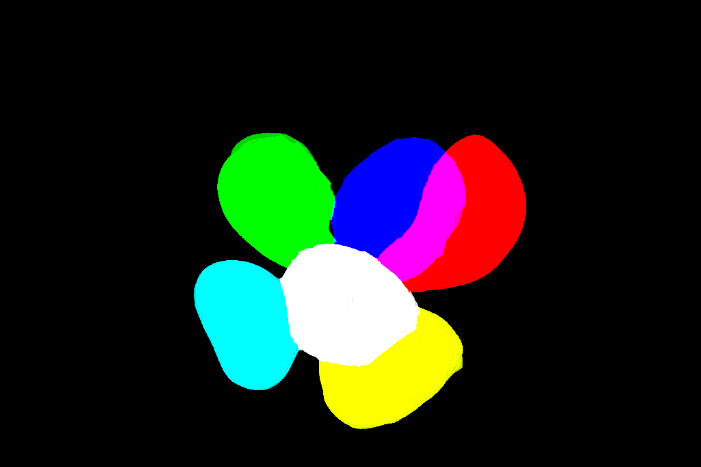
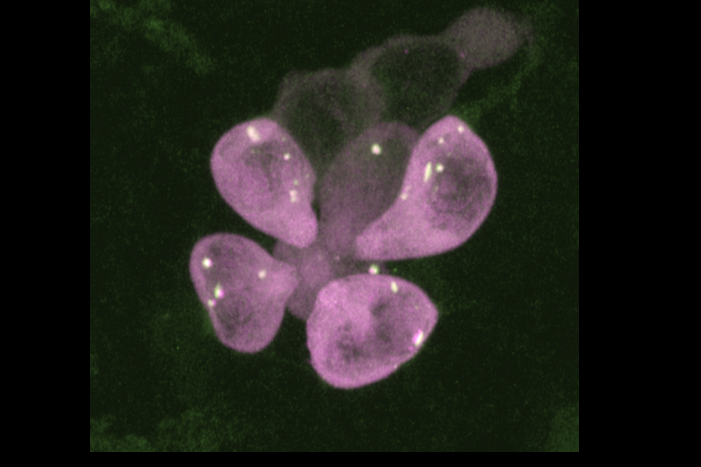
Built a deep-learning-based pipeline to segment individual hair cells in 3D. This approach combines Cellpose with custom tracking to visualize development and synapse formation over time, enabling quantitative analysis of cellular dynamics.
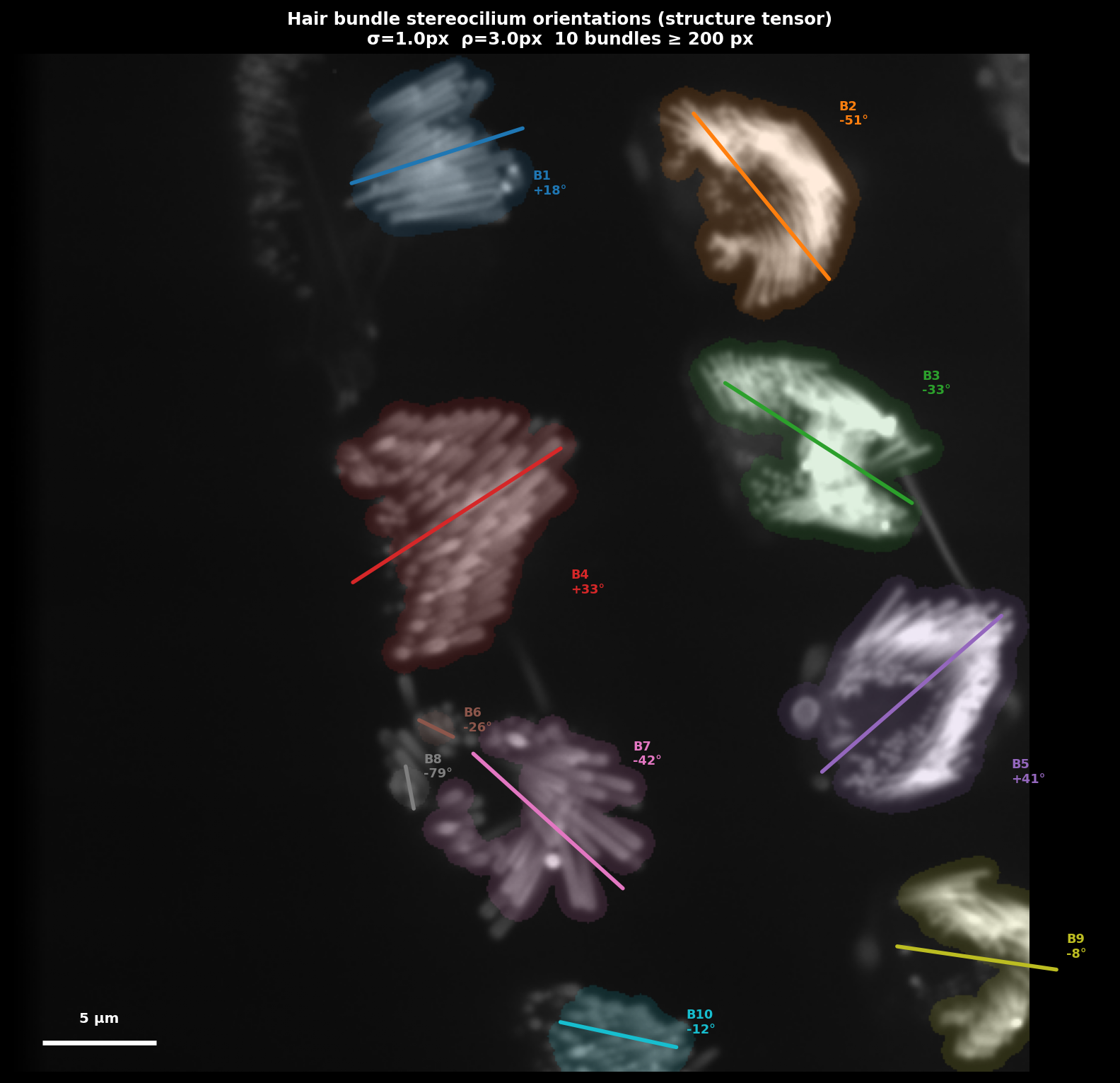
Developed a Python-based pipeline for automated detection of spontaneous calcium transients in GCaMP timelapse imaging of inner ear and vestibular hair cell stereocilia in mouse tissue explants.
Developed MATLAB pipelines for tracking protein motion in 2D and 3D in zebrafish hair cells, combining high-resolution imaging with quantitative motion analysis.
Built a segmentation and contour-analysis pipeline to study bacterial morphology to help link shape differences to genetic perturbations.
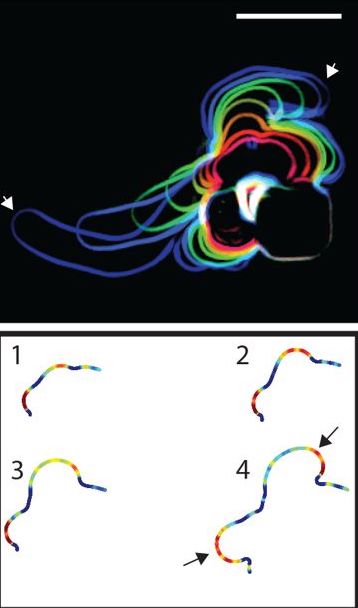
Applied particle tracking to classify MreB filament motion using mean-squared displacement analysis to distinguish directional vs diffusive behavior.
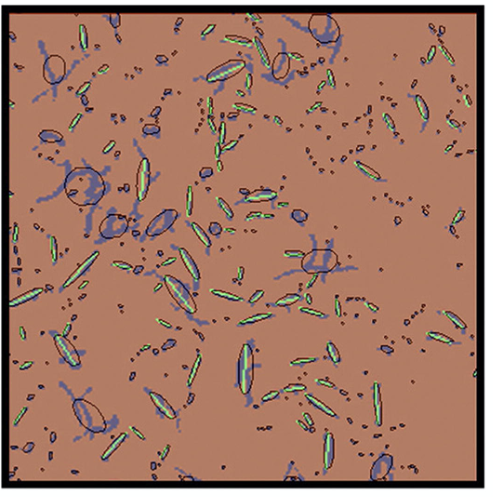
Developed an image-analysis method to quantify actin filament orientation using ellipse fitting in time-lapse microscopy. This enables comparison of cytoskeletal organization across conditions.
Integrated Leap Motion with PyMOL to control molecular structures using hand gestures. Enables intuitive rotation, zooming, and interaction—ideal for research demos and teaching.
03Publications
Full list on Google Scholar →
04Curriculum Vitae
Training and evaluating frontier large language models on PhD-level scientific reasoning.
Sensory hair cell research using advanced fluorescence microscopy and live cell imaging in zebrafish and mouse models.
Doctoral research in cell biology - Using quantitative live fluorescence imaging to understand how bacteria form rod shapes.
Live Imaging · Confocal microscopy · Light-sheet microscopy · TIRFM · Calcium imaging (GCaMP) · Zebrafish and mouse genetics · CRISPR · Molecular Biology
Python · · FIJI/ImageJ · R · MATLAB · LLM evaluation & RLHF · 2D/3D particle tracking & 2D/3D cell segmentation
05Contact
Open to collaborations in sensory neuroscience, AI and biology, and LLM evaluation. Feel free to reach out.